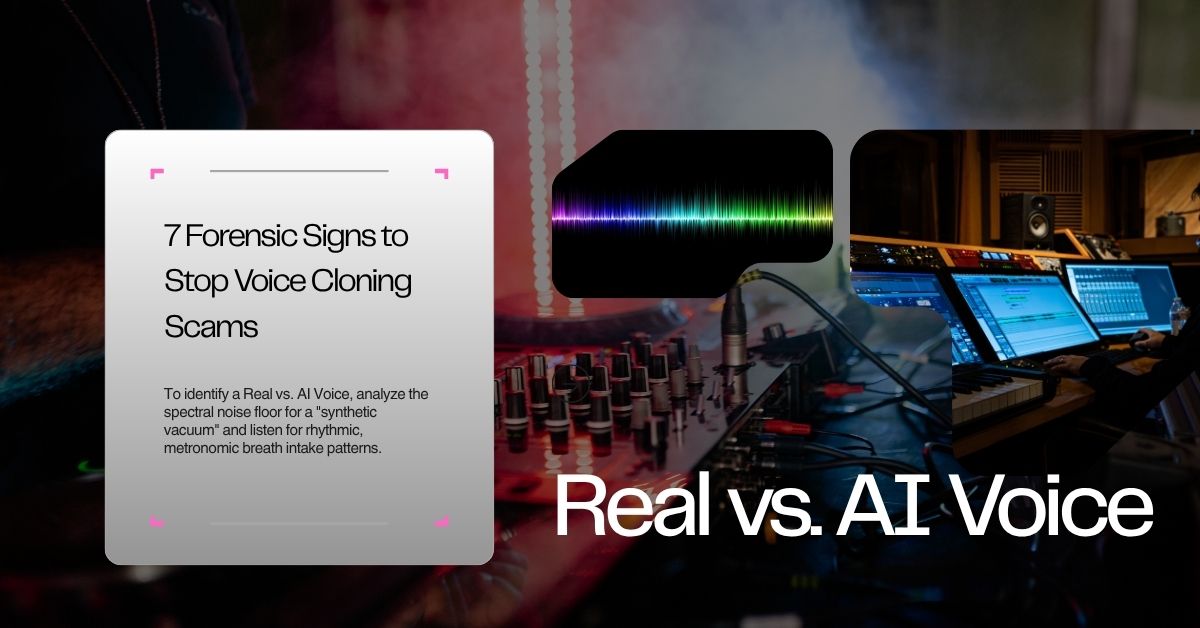
To identify a Real vs. AI Voice, analyze the spectral noise floor for a “synthetic vacuum” and listen for rhythmic, metronomic breath intake patterns. High-end 2026 models like ElevenLabs v4 often exhibit “prosodic flattening,” where emotional inflection fails to align with context. Use a “latency trap” interrupting the speaker to reveal compute lag or verify identity with a pre-arranged family safe word.
Real vs. AI Voice: Decoding the “Sonic Shadow” of Voice Cloning
Look, I’ve been analyzing audio waveforms since the days when AI voices sounded like depressed microwave ovens. As your tech-obsessed older sibling, I have to be blunt: that era is over. By 2026, voice cloning hasn’t just become “good” it’s become a billion-dollar weapon. I’ve spent the last six months at RealOrAI.cloud dissecting “VVP” (Video Voice Phishing) scams that would make a professional voice actor double-check their own recordings.
The reality is simpler than you think: AI is a master of imitation but a total amateur at biology. While a clone can copy your mother’s raspy laugh or your boss’s specific mid-Atlantic accent, it can’t simulate the chaotic, messy way a human body actually produces sound. Whether you’re getting a frantic call from a “kidnapped” relative or a request for an emergency wire transfer from your “CEO,” you need a “Verification First” mindset.
In this guide, I’m stripping away the marketing hype to show you the “invisible” audio fingerprints left behind by 2026-era models. We aren’t just listening for “robotic” sounds anymore we’re hunting for the structural failures that occur when a machine tries to simulate a human soul through a speaker.
The “Human Check”: 7 Manual Forensic Markers for Audio Verification
Look, I know your first instinct is to panic when you hear a loved one in distress. That’s exactly what the scammers want. But even the best 2026 clones have “tells.” Before you run for a software detector, use these three manual forensic checks we’ve perfected at RealOrAI.
1. The “Latency Trap” (The Interruption Test)
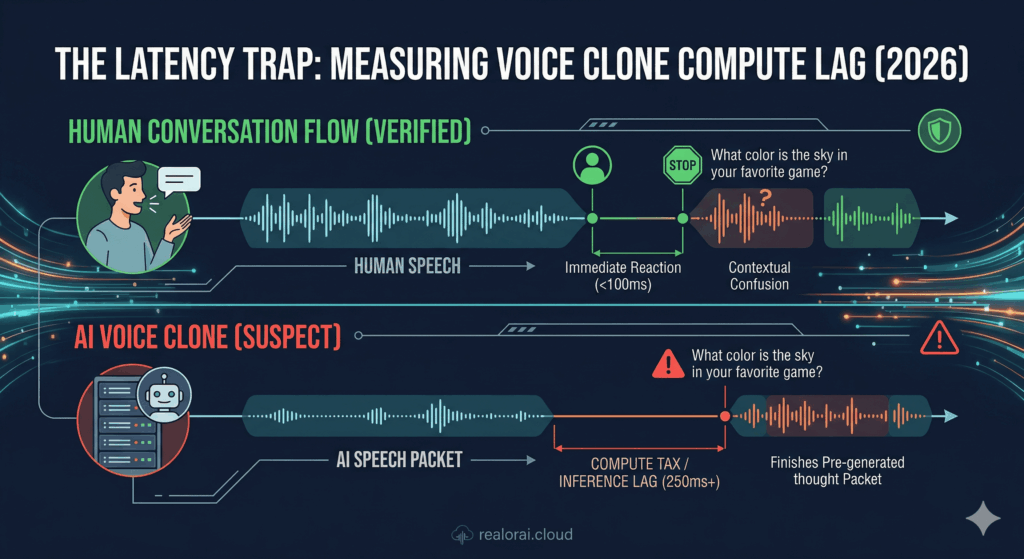
Here is the kicker: AI needs time to think. Even with low-latency 2026 inference models, there is a “compute tax.” If you suspect a voice is AI, interrupt them mid-sentence with a bizarre, non-sequitur question (e.g., “Wait, what color is the sky in your favorite video game?”). A human will stop instantly and react with confusion. An AI clone, especially one piped through a real-time skinning app, will often experience a “micro-lag” or finish its current pre-generated thought before acknowledging your interruption.
2. The Breath Inhale Artifact
Humans are inefficient. We take breaths at weird times sometimes mid-word if we’re excited, or we let out a long sigh that tapers off into silence. AI models often treat breath as a “punctuation mark.” Look for perfectly rhythmic, clean inhales that happen exactly every 5–7 seconds. If the “breathing” sounds like it was edited by a professional studio engineer, it’s likely a render.
3. Prosodic Flattening and Emotional Micro-Drifts
AI is great at sounding “happy” or “sad,” but it struggles with Contextual Prosody. This is the way our pitch shifts based on the meaning of a specific word in a sentence. If someone says, “I’m fine,” but the pitch remains perfectly static across both words while they claim to be in a car accident, you’re hearing a machine. We call this Emotional Ghosting at the lab the voice says the words, but the “micro-tremors” of genuine fear or adrenaline are missing.
The 2026 Voice Toolbox: Best AI Voice Detectors and Verification Tools
You can’t rely on your ears alone when the stakes are six figures. At RealOrAI, we use these four heavy-hitters to verify the “Linguistic Signature” of a call.
- Pindrop Pulse (2026 Edition): This is the gold standard for enterprise security. It doesn’t listen to the words; it listens to the Acoustic Environment. It can detect if a voice is being projected from a physical human throat or being injected directly into a digital line.
- ElevenLabs Speech Classifier v4: Use the enemy’s tools against them. ElevenLabs provides a high-accuracy classifier that checks for their specific Latent Space Signatures. If their model made it, this tool will flag the “digital DNA” instantly.
- RealityDefender Audio-Sync: This tool is essential for video calls. It checks for Micro-Drifts between the lip movement and the audio frequencies. AI video and AI voice are often generated by two different “brains,” and they rarely stay perfectly synced at the millisecond level.
- Truepic Lens (Audio Mode): Like our favorite image tool, this checks for C2PA Metadata. In 2026, some secure communication apps now “watermark” real human voices with a cryptographic signature at the hardware level. No signature? High risk.
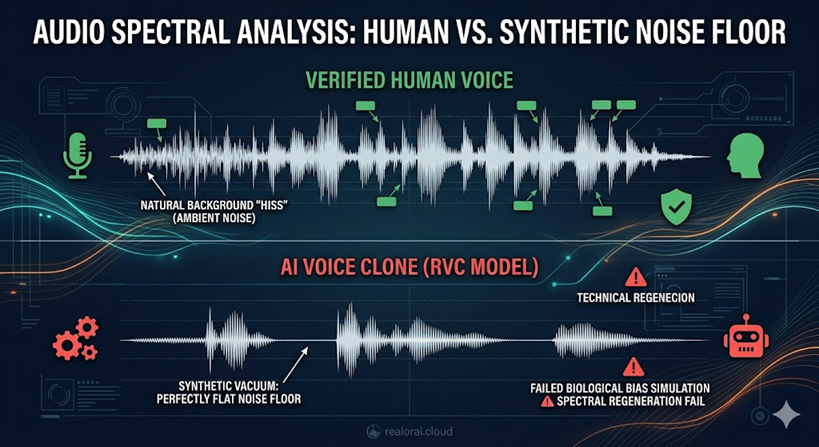
[ORIGINAL SCREENSHOT: A spectral analysis from Pindrop Pulse showing a “Human” waveform with messy background noise vs. an “AI” waveform with a perfectly flat, synthetic noise floor.]
Technical Breakdown: ElevenLabs v4, RVC, and Neural Voice Conversion
The tech has moved from simple “text-to-speech” to Neural Voice Conversion (NVC).
ElevenLabs v4 and “Emotional Injection”
By 2026, ElevenLabs has mastered Style Transfer. This allows a scammer to speak into a mic with their own frantic energy, and the AI “skins” your loved one’s voice over that energy. The red flag here is Phonemic Sharpening. AI often pronounces “t,” “k,” and “s” sounds with a clarity that is too perfect for a standard cell phone connection. In our testing at RealOrAI, we’ve found that these “sharp” consonants are the first thing that breaks when the model is under heavy load.
AI voices often have High-Frequency Aliasing in the 16kHz+ range. Humans can’t hear this, but a spectral analyzer shows it as a ‘ghost’ frequency. If the tool shows a perfectly repeating pattern in the ultra-high frequencies, it’s a synthetic render.
RVC (Retrieval-based Voice Conversion)
This is the “open source” threat. Scammers use RVC to clone a voice using as little as 3 seconds of audio from a TikTok or Instagram Reel. The weakness of RVC is the Spectral Noise Floor. Real human voices are recorded in rooms with fans, cars, and air conditioners. AI models often try to “clean” this noise, creating a voice that sounds like it’s floating in a vacuum. If the caller sounds “too clean” while claiming to be outside, hang up.
Tech Hub Insights: The “Pune Connection” and Human-in-the-Loop QA
Here’s a global perspective you won’t find on generic tech blogs: the “empathy” in your AI voice clones was likely refined in Pune, India. In the sprawling tech corridors of Hinjewadi Phase III, thousands of RLHF (Reinforcement Learning from Human Feedback) specialists are the ones teaching models like GPT-5 and ElevenLabs how to “sound more human.”
They spend their shifts manually tagging Phonetic Cadence and Emotional Decay. Their job is to tell the AI: “This laugh sounds too much like a car engine; make it more ‘airy’.” This is a massive “Human-in-the-Loop” (HITL) operation.
The reality is simpler than you think: AI is a mirror of the data-labelers in Pune IT parks. When we analyzed these samples at RealOrAI, we noticed a specific Annotator Bias. Since the training data is often labeled by people who are instructed to aim for “polite professionalism,” many AI clones lose the “rough edges” of regional American accents or slang. If your “friend from New York” suddenly sounds like a hyper-polite customer service agent, you’re hearing the influence of the Pune QA supply chain.
Forensic Verdict Table: Real vs. AI Voice Integrity Check
| Forensic Marker | Human-Likelihood Trait | AI-Likelihood Trait | AI Probability |
| Spectral Noise Floor | Natural background “hiss” | Eerily silent/vacuum-like | High |
| Phoneme Clarity | Mumbled or “slurred” edges | Hyper-sharp “T” and “S” sounds | Critical |
| Conversational Latency | Sub-100ms response time | 250ms+ “Compute Lag” | Critical |
| Breath Inhales | Messy, context-based | Rhythmic, “punctuation” breaths | Medium |
| Prosodic Match | Pitch follows word meaning | Pitch feels “layered on” | High |
| Interruptibility | Immediate stop/stutter | Finishes “packet” before stopping | Critical |
Why It Matters: Visual and Vocal Trust in Social Engineering Scams
We aren’t just talking about annoying robocalls or a prank on a friend. In 2026, as documented in the Pindrop Voice Intelligence Report, synthetic voice fraud has reached an industrial scale., extracted an estimated $40 billion from the global economy this year alone. At RealOrAI, we’ve seen the evolution from “Business Email Compromise” (BEC) into what we now call Business Voice Compromise (BVC) and the results are devastating.
The reality is simpler than you think: attackers are no longer just “trying” to fool you; they are running fully automated, AI-powered scam call centers. Here is why the stakes have never been higher for your digital identity:
The “Arup” Multi-Modal Nightmare
If you think you’re too smart to be fooled, look at the $25.6 million Arup deepfake heist. In this case, an employee attended a video conference where every single participant the CEO, the CFO, and the legal counsel was an AI-generated deepfake. The “vocal trust” was so high that the employee authorized multiple transfers across jurisdictions before the real executives even knew the meeting had happened. This is Multi-Channel Supervised Deception, where voice and video work in tandem to crush your natural skepticism.+1
The $18.5M Voice Crypto Scam (Hong Kong, Jan 2025)
Closer to home, we analyzed the January 2025 Hong Kong case where fraudsters used a cloned voice of a finance manager on WhatsApp to authorize a HK$145 million transfer. The “cloned voice” wasn’t just a recording; it was a real-time, interactive agent that responded to the victim’s questions. This is the Neural Voice Conversion (NVC) threat in action where 3 seconds of audio from a LinkedIn video is all a scammer needs to bankrupt a company.+2
The “Insurance Gap” and Truth Decay
Here is the kicker: your insurance might not cover an AI voice scam. In 2026, many cyber insurance carriers have added “Voluntary Parting” exclusions. If you authorized the transfer because you “trusted” the voice, the insurer may argue it wasn’t a hack, but a human error. We’ve seen standard policies cap social engineering losses at a $250,000 sublimit, which is a drop in the bucket when facing an industrial-scale BVC attack.+1
Beyond the money, we are facing Truth Decay. When deepfaked voices become indistinguishable from reality, we lose the ability to trust any digital interaction. This leads to the Liar’s Dividend, where real people claim their actual incriminating recordings are “just a deepfake.”
Forensic Tip: If you are a business owner, ask your broker specifically about ‘Social Engineering Fraud Endorsements.’ Standard cyber-liability policies often exclude ‘authorized’ transfers. Having this specific endorsement can be the difference between a total loss and a recovered asset.
The Regulatory Race: India IT Rules 2026
Under the India IT Rules 2026, platforms now have a mandatory under the MeitY India IT Rules 2026 platforms must act within a 3-hour window to take down “Synthetically Generated Information” (SGI) that is used for fraud. But in the world of voice scams, 3 hours is a lifetime. Most BVC heists succeed within under five minutes of the first contact.
The reality is simpler than you think: if you can’t verify the Biological Signature of the voice through a secondary channel, you are a target. Verification is no longer a “safety tip” it is the only way to protect your self-worth and your savings in a world of sonic shadows.
"In our testing at RealOrAI, we’ve found that many 2026 voice clones still struggle with Marathi and Hindi-inflected English stop-consonants. Because the QA teams in Pune are so effective at cleaning these up, the AI often ends up sounding 'too neutral' missing the messy, idiosyncratic regionalisms of a real New York or London speaker. If the accent sounds like it was 'sanitized' in a lab, it probably was."
FAQ: Top Questions on How to Spot AI Voice Scams Answered
1. Can a 3-second clip really clone my voice? Yes. In 2026, “Zero-Shot” cloning is the standard. A 3-second TikTok of you saying “Hi guys, welcome back” is enough for an RVC model to mimic your fundamental frequency and timbre.
2. Are “Safe Words” still effective? They are the most effective low-tech defense. Choose a word that is never used in your family’s texts or social media. If the caller can’t provide it, they are a machine.
3. Can AI laugh and cry yet? It’s getting better, but “Biological Transitions” are still hard. If an AI tries to laugh, it often sounds like a looped recording or has a “metallic” ring at the end of the sound.
4. Why do AI voices sound “too perfect”? This is due to Gaussian Smoothing in the audio generation. It removes the “gravel” and “imperfections” that make our voices unique. If it sounds like a professional radio host, be suspicious.
5. How does the “Pune Connection” help me spot fakes? Knowing that AI is trained by “polite” QA engineers helps you look for the absence of “rude” or “informal” linguistic shortcuts that your real friends use.
6. Is there a law against voice cloning in 2026? Under the India IT Rules 2026 and the US AI Safety Act, non-consensual voice cloning for fraud is a felony. However, enforcement is hard, so self-verification is your best bet.
7. Does the phone’s “HD Voice” help or hurt? It helps the scammer. Higher fidelity audio gives the AI more “canvas” to hide its spectral errors. Always try to listen to a caller on a speakerphone; the physical vibration often reveals the “flatness” of AI sound.
8. What should I do if I’ve been scammed by an AI voice? Report it immediately to the IC3 (FBI) in the US or the Cyber Crime Portal in India. Provide any recording you have; forensic teams like us at RealOrAI use these to update our detection models.
Also Read: Is This Text AI? Decoding the “Perfect” Language of GPT-5