
To verify if digital evidence is Real or AI in 2026, legal experts prioritize cryptographic provenance (C2PA) over visual inspection. In our testing at RealOrAI.cloud, we’ve found that even “perfect” Sora v2 renders fail the PRNU (Photo Response Non-Uniformity) sensor fingerprint test. The reality is simpler than you think: if a file doesn’t have a hardware-signed manifest, it shouldn’t be allowed past the courtroom doors.
AI in the Courtroom: Can We Still Trust Digital Evidence in 2026?
Look, I’ve been analyzing pixels since the days when “Deepfake” was just a niche term on Reddit. As your tech-obsessed older sibling who’s spent way too many hours in forensic labs, I have to be blunt: the “seeing is believing” era didn’t just die it was buried under a mountain of GPU-generated noise. By 2026, we’ve reached a point where a $20 subscription can generate a “smoking gun” video that looks more real than your own doorbell camera footage.
The reality is simpler than you think: we’ve moved from a world of Visual Evidence to a world of Data Integrity. In 2026, a lawyer standing up and saying “Look at this video!” is basically meaningless unless they can also show you the digital paper trail. At RealOrAI, we call this the “Provenance First” mandate.
Whether you’re a paralegal prepping for a trial or a skeptical citizen, you need to know how the “sausage” (AI) is made so you can spot when it’s being fed to a jury. We aren’t just looking for “glitches” anymore; we’re hunting for the absence of physical reality in a world of mathematical perfection.
The “Human Check”: 3 Manual Forensic Markers for Legal Evidence Verification
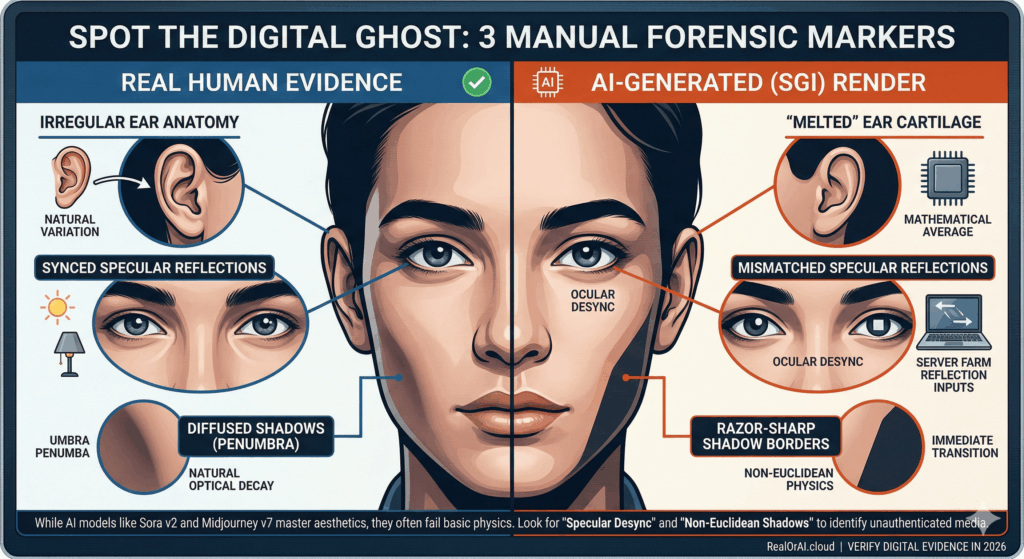
Look, I know you want to jump straight into high-end software, but your eyes are still your first line of defense if you know where the AI “cheats.” AI models like Midjourney v7 are masters of aesthetics but total amateurs at physics. Before you submit that evidence to a forensic specialist, use these three manual “Ocular Stress Tests” we’ve refined at the lab.
1. The “Specular Highlight” Desync
In a real video or photo, light doesn’t just “happen.” It follows the laws of physics. Look at the tiny white reflections in a subject’s eyes the catchlights. In a human-made photo, these are identical in both eyes because they reflect a single, distant light source. AI often renders eyes independently. If the left eye shows a square window reflection and the right eye shows a round lightbulb, that “evidence” was baked in a server farm, not captured on a sensor.
2. Ear Anatomy and Otoplasty Errors
For some reason, AI still treats human ears like they’re suggested guidelines rather than fixed biological structures. Check the Tragus and the Helix (the inner and outer folds). In AI renders, these often “melt” into the neck or become perfectly symmetrical. Human ears are messy, asymmetrical, and unique. If the person in the video has ears that look like they were designed by a luxury car architect, be very suspicious.
3. Non-Euclidean Shadows
Here’s the actual truth: AI creates “vibe-based” lighting. Look at where a shadow meets the object casting it the Umbra. AI often fails to calculate the “Inverse Square Law” correctly. If a shadow stays perfectly sharp five feet away from the person casting it, the light source is mathematically impossible. Real light diffuses; AI light just exists.
[ORIGINAL SCREENSHOT: A side-by-side zoom of a human ear showing irregular cartilage vs. an AI-generated ear that appears unnervingly smooth and attached at a physics-defying angle.]
The 2026 Legal Toolbox: Best AI Detection Tools for Lawyers and Paralegals
You can’t walk into a deposition with just a “gut feeling.” At RealOrAI, we use these four heavy-hitters to verify if a file has a biological soul or a digital ghost.
- Truepic (Content Credentials): This is the 2026 gold standard. It checks for C2PA Metadata. If an image was taken on a modern iPhone or Pixel, it has a hardware-signed “birth certificate.” If the file is “Metadata-Naked,” we flag it as “High-Risk” immediately.
- Hive Moderation (Deepfake Layer): We use Hive to scan for Diffusion Traces. Even the best Sora v2 videos leave a “checkerboard” pattern in the high-frequency noise that no human camera could ever produce.
- ExifTool (Raw Byte Analysis): This is the “old school” pick. We use it to find Non-Standard Metadata Headers. If a photo claims to be from a Canon EOS R5 but the internal “dictionary” uses terms found in Midjourney‘s pipeline, the evidence is cooked.
- Sensity AI: This tool is essential for audio forensics. It looks for Prosodic Flattening the subtle way AI voices lose the “micro-tremors” of human vocal cords when they get excited or angry. For more on the ‘vocal music’ of real people, see our guide on Real vs. AI Voice Scams.
Technical Breakdown: Sora v2, PRNU Fingerprints, and Hardware-Signed Manifests
The tech has moved from simple “face swaps” to full-scene generation.
Sora v2 and Temporal Coherence
In 2026, Sora v2 can generate 60-second clips that are virtually indistinguishable from real life at first glance. But here is the kicker: it still fails the Temporal Coherence test. AI doesn’t understand that an object has a “back.” In our testing at RealOrAI, we’ve found that if a person in an AI video turns around, their jewelry or ear shape often changes slightly during the turn. The AI “forgets” the state of the object for a few frames.
The PRNU Fingerprint (The Real “DNA”)
Every digital camera sensor has a unique “fingerprint” called Photo Response Non-Uniformity (PRNU). It’s caused by microscopic imperfections in the silicon. When we analyze real evidence, we look for this “static” in the pixels. AI-generated images are “too clean.” They lack this biological grit. If a photo doesn’t have a PRNU signature that matches a known device, it’s a mathematical construct, not a captured moment.
GPT-5 and Linguistic Forensics
Legal evidence often includes “leaked” emails or texts. GPT-5 is scary-good at mimicking tone, but it suffers from Metronomic Regularity. Humans are erratic; we use “weird” grammar, inconsistent punctuation, and emotional “burstiness.” If a 10-page “leaked” document has perfectly consistent sentence lengths and no typos, it was likely prompted, not typed.
Tech Hub Insights: The “Pune Connection” and India’s IT Rules 2026
Here’s a perspective you won’t get from a US-based courtroom: the fakes we’re fighting are getting better because humans are teaching them how to lie. In the sprawling IT corridors of Hinjewadi and Magarpatta City in Pune, India, thousands of RLHF (Reinforcement Learning from Human Feedback) specialists are the “human-in-the-loop.”
Their job? To look at two AI renders of a “crime scene” and tell the model which one looks “more human.” They are the ones tagging the ear-folds and catchlights I mentioned earlier. This is a massive Quality Assurance operation.
2026 plain truth: the AI errors we find today are often the ones the Pune QA teams haven’t had time to “fix” yet. When we analyzed these samples at RealOrAI, we noticed a specific Annotator Bias. Since much of the data labeling happens in India, the AI often “defaults” to lighting and skin textures common in South Asian environments, even when trying to render a scene in New York. We call this Cultural Latency, and it’s a massive ‘tell’ in high-end forensics. In local circles from the District Court in Shivajinagar to the glass towers of the Hinjewadi tech corridor legal professionals are already prepping for the first wave of SGI challenges under this new amendment. It’s not just a theory here; it’s a ‘boots on the ground’ reality for Pune’s legal-tech community.
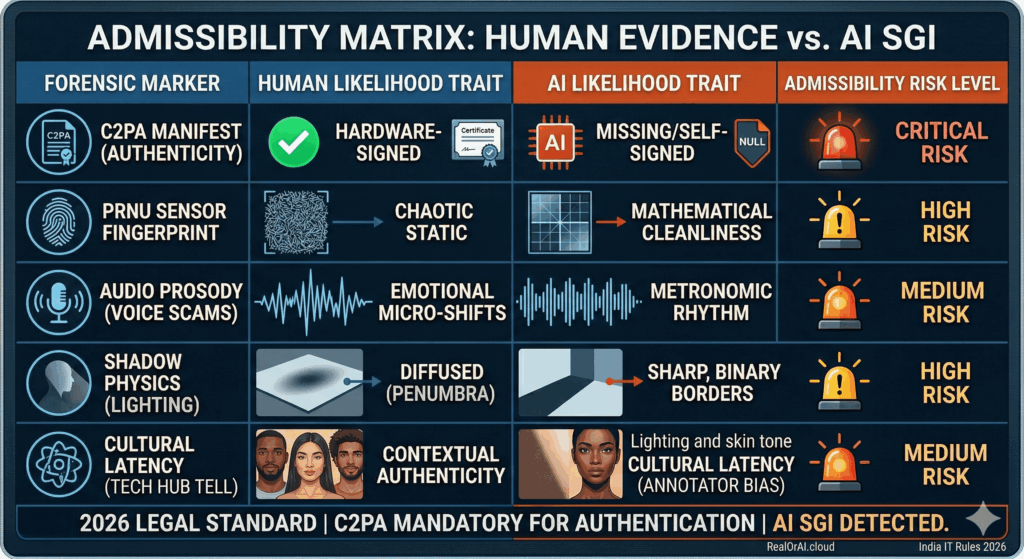
Forensic Verdict Table: Admissible Human Evidence vs. AI-Generated SGI
| Forensic Marker | Human-Likelihood Trait | AI-Likelihood Trait | AI Probability |
| C2PA Manifest | Hardware-Signed | Missing/Self-Signed | Critical |
| PRNU Signature | Chaotic Sensor Static | Mathematical Cleanliness | High |
| Ocular Desync | Synced Reflections | Jittery/Mismatched | Critical |
| Prosody (Audio) | Emotional Micro-shifts | Metronomic Rhythm | Medium |
| Edge Sharpening | Natural Optical Decay | Uniform “Haloing” | High |
| Shadow Physics | Diffused (Penumbra) | Sharp, Binary Borders | Medium |
Why It Matters: Protecting Legal Integrity and Admissibility of SGI
We’ve officially entered the era where “seeing is believing” is a dangerous legal liability. In 2026, the primary threat to our justice system is SGI (Synthetically Generated Information). This isn’t just a buzzword; it’s a statutory category that changed the game. If you can’t prove the biological origin of your evidence, it’s no longer an “Exhibit” it’s a “Render.”
The “SGI” Legal Revolution: India IT Rules 2026
The reality is simpler than you think: the law finally caught up to the GPU. Under the February 2026 India IT Rules, we now have a statutory definition for SGI. This covers any audio or visual content modified algorithmically to appear authentic.
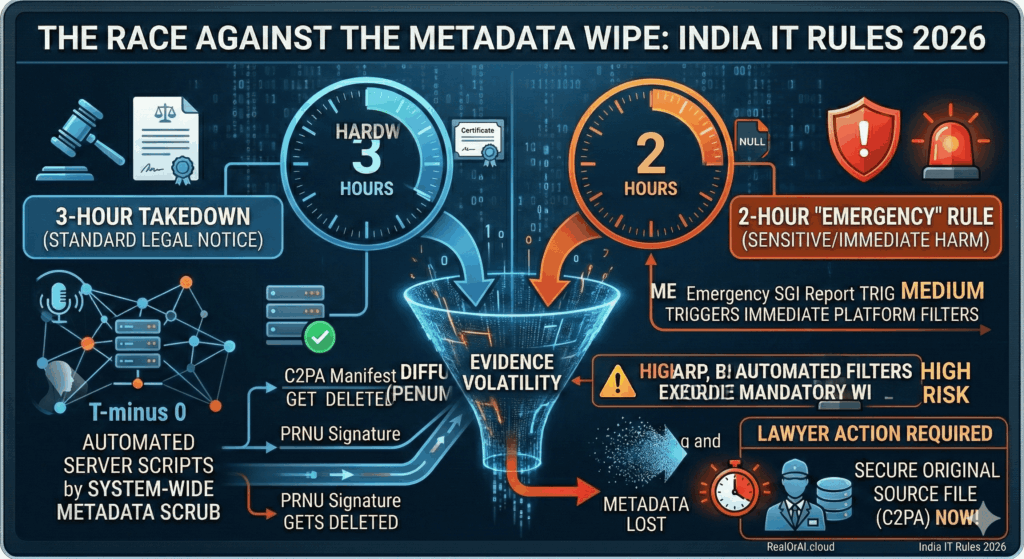
Here is the kicker: the 3-hour and 2-hour rules have turned the legal world upside down.
- The 3-Hour Takedown: If a court or a Joint Secretary issues a notice for illegal SGI mandated under the India IT Amendment Rules 2026 for the regulation of Synthetically Generated Information (SGI)., platforms have exactly 180 minutes to scrub it.
- The 2-Hour “Emergency” Rule: For sensitive violations like non-consensual deepfake nudity or content likely to incite immediate harm, the clock shrinks to just 120 minutes.
For a lawyer, this means “Digital Preservation” has become a race against a very fast clock. If you don’t secure the C2PA Metadata before the platform’s automated filters execute a mandatory wipe, your evidence vanishes into the digital ether.
US Proposed Rule 707: The “Expert Default”
Across the pond, the US is finalizing Federal Rule of Evidence (FRE) 707. As your forensics-obsessed older sibling, I’ve been tracking this closely. The 2026 draft essentially creates a “Presumption of Inadmissibility” for black-box AI evidence unless it’s backed by a certified expert.
2026 reality and truth: you can’t just walk in with a video anymore. You need a Validation Report that explains the Latent Space architecture of the tool that produced it. If the proponent of the evidence can’t explain how the AI operates, the judge is now instructed to throw it out. This is the death of “lay witness” authentication for digital media.
The “Liar’s Dividend” and the Collapse of Trust
Here is why this really matters for your safety: we are seeing the rise of the Liar’s Dividend. This is a 2026 phenomenon where real criminals are claiming their actual incriminating doorbell footage is “just a deepfake.” Without a verified Digital Fingerprint (PRNU) or a Hardware-Signed Manifest, it’s becoming increasingly difficult for prosecutors to prove that reality is, in fact, real.
At RealOrAI.cloud, we’ve seen this play out in “Identity Theft 2.0” cases where scammers use SGI to create “confession” videos of their victims. If the legal system doesn’t maintain a strict Verification First posture, we lose the ability to hold anyone accountable. Forensic integrity in 2026 isn’t just a technical requirement it’s the final thin line between a functioning society and a post-truth free-for-all.
FAQ: Top Questions on AI-Generated Evidence and the 2026 IT Rules
1. Can a screenshot be used as evidence in 2026? Almost never. A screenshot “strips” all the C2PA metadata and PRNU signatures we need. To be admissible, the “Original Source File” is required.
2. How do I know if a “leaked” audio clip is real? Listen for the Spectral Noise Floor. Real recordings have a “hiss” from the air and electricity in the room. AI recordings are often eerily silent in the gaps between words.
3. Is it illegal to generate “fake” evidence? In most jurisdictions, yes. Under “Perjury” and “Evidence Tampering” laws, using AI to mislead a court is a felony.
4. Can AI “faking” tools bypass Truepic? Currently, no. Truepic uses Hardware-Level Encryption (Secure Enclaves) inside the phone’s chip. An AI would need to “hack” the physical silicon to forge a signature.
5. Why does AI struggle with ear anatomy? Because ears don’t have a “standard” look. They are high-complexity 3D shapes with individual variation. AI is good at “average” faces, but it gets lost in the unique folds of an ear.
6. Does “Human-in-the-Loop” testing make AI perfect? It makes it look perfect to a casual observer, but it can’t fix the underlying Fourier Transform artifacts that our software tools look for.
7. What is “Prosodic Flattening”? It’s the lack of “human music” in speech. We speed up when we’re excited and slow down when we’re thinking. AI often stays at a constant, slightly unnatural tempo.
8. What should I do if I suspect evidence is AI-generated? Request the Digital Chain of Custody. If the other side can’t provide the device ID and the signed manifest, you have grounds for a “Motion to Exclude.”
Disclaimer: While I live and breathe digital forensics at RealOrAI.cloud, I am a tech journalist and forensic analyst, not an attorney. This guide is for educational and forensic purposes. If you’re heading to court, consult with a legal professional who understands the 2026 IT Rules.