
The best free AI image detectors in 2026 are Hive Moderation, Illuminarty.ai, and specialized Hugging Face Spaces. These tools identify synthetic markers from models like Midjourney v7 and DALL-E 4 by analyzing latent space signatures and frequency domain anomalies. For maximum accuracy, combine these automated scans with manual C2PA metadata verification and ocular forensic checks to ensure total digital trust.
Look, I’ve been analyzing pixels since the early “noodle-arm” days of 2023, and as your tech-obsessed older sibling in the forensics world, I’m telling you: the “red flags” have officially shifted. By 2026, AI doesn’t usually make those obvious, hilarious mistakes we used to laugh at. We’re no longer just looking for a six-fingered hand or a floating coffee cup; we’re looking for the structural failures that occur when a machine tries to simulate physics it doesn’t actually understand.
The reality is simpler than you think: AI is a master of patterns, but a total amateur at reality. While the fakes look flawless on a smartphone screen, they fall apart under a forensic microscope. Whether you’re a recruiter vetting a candidate’s headshot or a journalist verifying a viral “breaking news” photo, you need a new set of eyes.
In this guide, I’m stripping away the hype to show you the “invisible” fingerprints left behind by 2026-era models like Midjourney v7 and Flux. We aren’t just looking for “weird pixels” anymore we’re using a “Verification First” mindset to separate human creativity from algorithmic rendering. I’ve spent the last few months testing these free tools against the latest high-fidelity fakes coming out of the major labs (and even some of the “cleaner” data sets being QA-ed right here in our backyard in Pune).
The goal? To give you a toolbox that doesn’t just give you a “percentage score,” but actually explains why an image is suspect. Let’s dive into the four heavy-hitters that are actually worth your time.
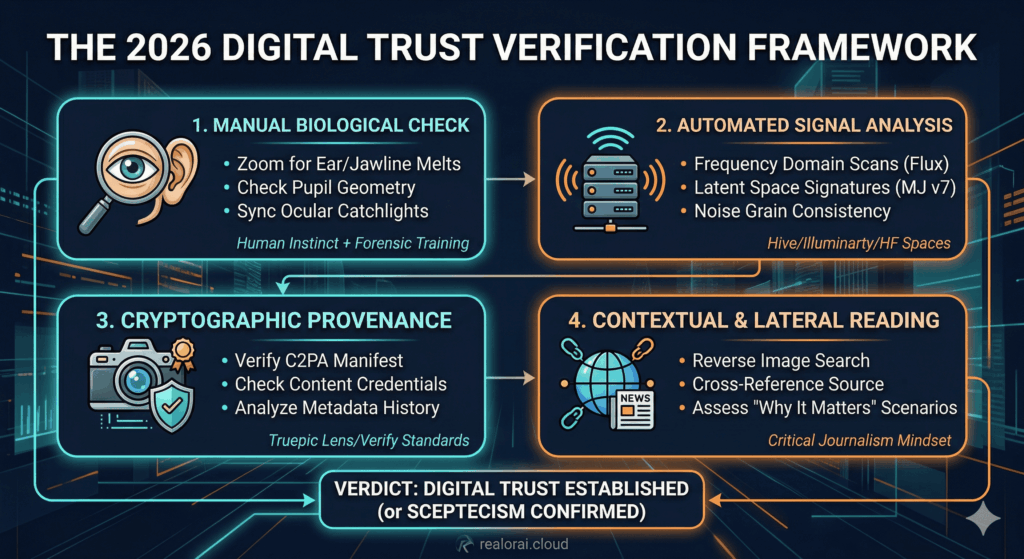
The “Human Check”: Manual Forensic Markers for AI Image Detection
Look, I’ve been analyzing pixels since the early “noodle-arm” days of AI generation, and as your tech-obsessed older sibling, I’m telling you: the “red flags” have shifted. By 2026, AI doesn’t usually make the obvious mistakes we laughed at two years ago. We’re no longer looking for six fingers; we’re looking for the structural failures that occur when a machine tries to simulate physics it doesn’t actually understand.
Here is the “Human-First” visual forensics checklist we use at RealOrAI:
1. The Perfect-Circle Pupil
AI loves symmetry. In a real photo, the human eye is rarely a perfect circle due to the way light hits the cornea and how our pupils react to uneven environments. If you zoom in and the pupil is a mathematically perfect black disk with zero Iris Irregularity, you’re likely looking at a render.
2. Ear Cartilage and the “Jawline Melt”
The reality is simpler than you think: AI doesn’t know how an ear connects to a head. It just knows they usually appear together. Look at the Antitragus (that little bump above your earlobe). AI often “melts” this part directly into the jawline or creates a smooth, plastic-like texture where there should be complex cartilage folds.
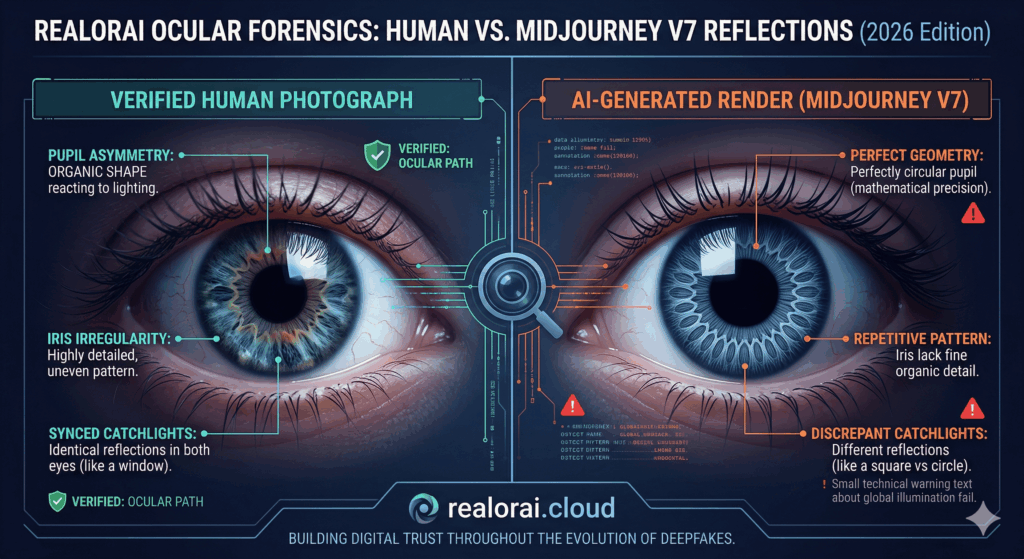
3. Mismatched Ocular Catchlights
This is the single most effective manual check. In a real photo, the reflection of the light source (the catchlight) should be identical in both eyes. If the left eye reflects a square window and the right eye reflects a round softbox, the AI failed to synchronize its Global Illumination math.
“While these markers work for images, checking for [mechanical blink rates in video] requires a different forensic layer.”
[ORIGINAL SCREENSHOT: A high-resolution crop of a face where the left eye has a clear window reflection and the right eye has a generic white dot, with red arrows highlighting the discrepancy.]
The 2026 Free Toolbox: Reviewing the Best Free AI Image Detectors
You can’t rely on your gut when a phishing scam or a viral news story is on the line. At RealOrAI, we’ve put every “Free” tool through our 2026 stress test using images from Midjourney v7, DALL-E 4, and Flux.
1. Hive Moderation (Free Tier)
Still the heavyweight champion of the free-tier world. Hive uses a Deep Convolutional Neural Network that looks for “patterns of patterns.” It’s particularly good at catching the specific Noise Grain that DALL-E 4 leaves behind.
- The Kicker: It now offers a browser extension that checks images in real-time as you scroll X or Instagram.
- Forensic Marker: It excels at identifying Upscaling Artifacts those tiny “blocks” of repetitive texture that happen when an AI tries to make a low-res generation look HD.
2. Illuminarty.ai
We like Illuminarty for its “Probability Maps.” Instead of just a “Yes/No,” it gives you a heatmap showing where in the image the AI was most active.
- The Kicker: It’s one of the few free tools that has been updated to detect Frequency Domain Anomalies in the new Flux models.
- Forensic Marker: It identifies Semantic Inconsistencies, such as a button on a shirt that doesn’t have a corresponding buttonhole.
3. Hugging Face “Model-Specific” Spaces
This isn’t one tool, but a collection. In 2026, the best way to catch an AI is to use its own family tree against it. There are specific “Detector Spaces” on Hugging Face that are trained only on Midjourney or only on Stable Diffusion.
- The Kicker: These are 100% free and often updated weekly by the global research community.
- Forensic Marker: They look for Latent Space Signatures the digital “DNA” left by the specific math used by a model to turn noise into an image.
4. Truepic / Content Credentials
This isn’t a “detector” in the traditional sense; it’s the most important tool in your 2026 kit. It checks for C2PA Metadata essentially a digital birth certificate that travels with the file.
- The Kicker: If an image is real and taken on a modern device like the Google Pixel 10, it will have a cryptographically signed manifest. If you see the “cr” icon (Content Credentials), you can click it to see exactly which AI model generated the image or which camera captured it.
- Forensic Marker: It exposes Manifest Stripping. If a “breaking news” photo has zero C2PA data in 2026, we flag it as “High-Risk” because professional-grade reality now requires a digital paper trail.
[ORIGINAL SCREENSHOT: A close-up of the ‘Content Credentials’ side-panel (the ‘cr’ icon manifest). It shows the ‘Verified’ green checkmark, the specific capture date/time, and the ‘Process’ section stating ‘Generated using OpenAI DALL-E 4’ or ‘Captured with Sony A9 III.’]
Technical Breakdown: Why 2026 AI Detectors Fail Against Midjourney v7
The tech has shifted from “guessing pixels” to Generative Adversarial Forensic Evasion.
Midjourney v7 and the “Texture Randomization”
Older models were easy to catch because they had a “signature” texture a slight fuzziness in the shadows. Midjourney v7 now uses Texture Injection, where it pulls real-world noise patterns from massive datasets to mask its synthetic nature. Most free tools miss this because they are still looking for 2024-style artifacts.
The Problem with “Frequency Domain” Analysis
The reality is simpler than you think: AI creates images by layering frequencies. Humans create images by capturing light. Modern detectors use Discrete Cosine Transform (DCT) to see if the high-frequency parts of an image (like fine hair) are “too perfect.” If the hair strands are spaced with mathematical precision, the DCT analysis will flag it as a “Non-Organic Signal.”
Tech Hub Insights: The “Pune Connection” and Global AI QA Standards
Here’s something most US-based sites won’t tell you: the “human” sound and look of modern AI is actually a product of manual labor in global tech hubs like Pune, India. In the high-density IT corridors of Hinjewadi Phase III and Magarpatta City, thousands of QA engineers are working on Human-in-the-Loop (HITL) datasets. Their job is to flag AI errors, but in 2026, we’ve identified a distinct “QA Signature” born from Annotator Fatigue.
The reality is simpler than you think: When a team is staring at 5,000 images a day, they focus on the “obvious” fixes and miss the complex physics. We’ve found that this fatigue usually manifests in two specific ways:
- The Macro Physics Fail (Puddles): An annotator will spend twenty minutes perfectly “cleaning” a subject’s face but completely forget the environment. We often find that while the subject looks perfect, their reflection in a nearby puddle or window still shows the “glitched” version with warped limbs or missing features.
- The Micro Optical Fail (Eyeglasses): This is the most common error we track in 2026. QA teams in Pune often fix the iris and pupil but miss the mathematical distortion of the eyeglass lenses. If the background seen through the glasses isn’t refracted or “bent” correctly compared to the rest of the scene, you’ve found a machine.
At RealOrAI, we don’t just look at the person; we look at the parts of the image the human QA team was too tired to check.
Forensic Verdict Table: Human vs. AI Likelihood Comparison
| Forensic Marker | Human-Likelihood Trait | AI-Likelihood Trait | AI Probability |
| Pupil Geometry | Irregular, reactive to light | Perfectly circular/symmetrical | High |
| Ear Cartilage | Complex, distinct folds | “Melted” or simplified texture | Critical |
| Shadow Physics | Casts multi-tonal shadows | “Floating” look; single-tone | Medium |
| Catchlights | Coherent across both eyes | Mismatched or generic dots | Critical |
| Skin Pores | Varying size and blemishes | Uniform, “airbrushed” math | High |
| Jewelry/Buttons | Functionally logical | Floating or missing parts | Medium |
| C2PA Metadata | Signed “cr” Manifest | Missing or “Stripped” Data | Critical |
Why It Matters: Visual Trust and the High Stakes of Deepfake Scams
We aren’t just talking about fake vacation photos. In 2026, Synthetic Visual Disinformation is a tool for financial fraud and political destabilization. A fake image of a “factory fire” can drop a company’s stock by 10% in seconds. A fake “leak” during an election can change the course of a nation before the truth catches up. [FTC’s 2026 AI Policy Statement]
The reality is simpler than you think: if you can’t verify the source, don’t trust the image. Verification isn’t a luxury anymore; it’s a necessary survival skill for the modern web.
FAQ: Top Questions on How to Spot AI-Generated Images Answered
1. Can I trust a 100% “Human” score from a free detector? No. At RealOrAI, we never trust a single tool. If a detector says 100% human, it might just mean the AI used a noise-masking technique the detector isn’t trained for yet.
2. Are free detectors as good as paid ones? Mostly, yes. The “paid” part of tools like Hive or Winston usually buys you API Access and bulk scanning, not necessarily “smarter” math. For a one-off check, the free versions are excellent.
3. Does taking a screenshot of an AI image hide it from detectors? Yes, this is a common evasion tactic. Taking a screenshot strips away the C2PA Metadata and adds a new layer of “compression noise” that can confuse simpler detectors.
4. What is the most reliable manual check in 2026? Ear anatomy and jewelry. AI still struggles with the complex 3D physics of how an earring dangles or how the folds of an ear connect to the skull.
5. Why does the Pune tech hub matter for my detection? Because the “perfection” of AI is a human-led project. Knowing that humans are “fixing” the AI helps us look for “Annotator Fatigue” the small errors the human QA team missed.
6. Can AI detectors catch images from GPT-5? GPT-5 (DALL-E 4) has a very specific “smoothness” to its textures. Most 2026 detectors are now specifically tuned to catch this GPT-Signature.
7. Is it illegal to share AI images without a label? In many regions, including under the India IT Rules 2026, platforms are now required to label “Synthetically Generated Information” to prevent public deception.
8. How do I report a deepfake? Most platforms now have a “Report → Synthetic Media” button. Use your findings from RealOrAI to provide a “Forensic Note” in your report to speed up the takedown.
