
TL;DR: The Evolution of Deepfakes has officially graduated from blurry face-swaps to pixel-perfect physics simulations in 2026, making manual detection a high-stakes psychological game. While the latest models have solved the “jitter” of the past, we’ve discovered that Temporal Coherence and the subtle math of Subsurface Scattering remain the final frontiers where AI still trips up. To stay safe in this new landscape, you must stop looking for obvious “glitches” and start verifying Biological Signatures and cryptographic provenance.
Welcome to the Era of “Perfect” Deception: The Evolution of Deepfakes
If you remember the rubbery, glitchy videos from 2024, I have some bad news: those days are gone. I’ve spent the last year at RealOrAI analyzing “candid” clips that would have fooled even the most seasoned forensics teams just eighteen months ago. The Evolution of Deepfakes in 2026 isn’t just about better graphics; it’s about generative models that now understand gravity, light bounce, and even how blood flow affects skin tone.
The reality is simpler than you think: AI is a master of patterns, but it’s still an amateur at physics. While the fakes look flawless on a smartphone screen, they fall apart under a forensic microscope. Whether you’re a business owner trying to verify a “FaceTime” from your CFO or a concerned citizen watching a viral political leak, you need a new set of eyes.
In this guide, I’m acting as your tech-obsessed older sibling to show you the “invisible” fingerprints left behind by 2026-era models like Sora and Veo. We aren’t just looking for “weird pixels” anymore we’re looking for the structural failures that occur when a machine tries to simulate a soul.
The “Human Check”: Spotting Synthetic Motion and AI Video Glitches
Look, I’m your tech-savvy older sibling, and I’ve seen enough “perfect” AI videos to tell you: your gut feeling is still your best weapon, but it needs an upgrade for 2026. The days of “weird teeth” and “six fingers” are mostly over. Today’s fakes are high-definition, fluid, and terrifyingly convincing.
Here is the “Human-First” video forensics checklist we use at RealOrAI:
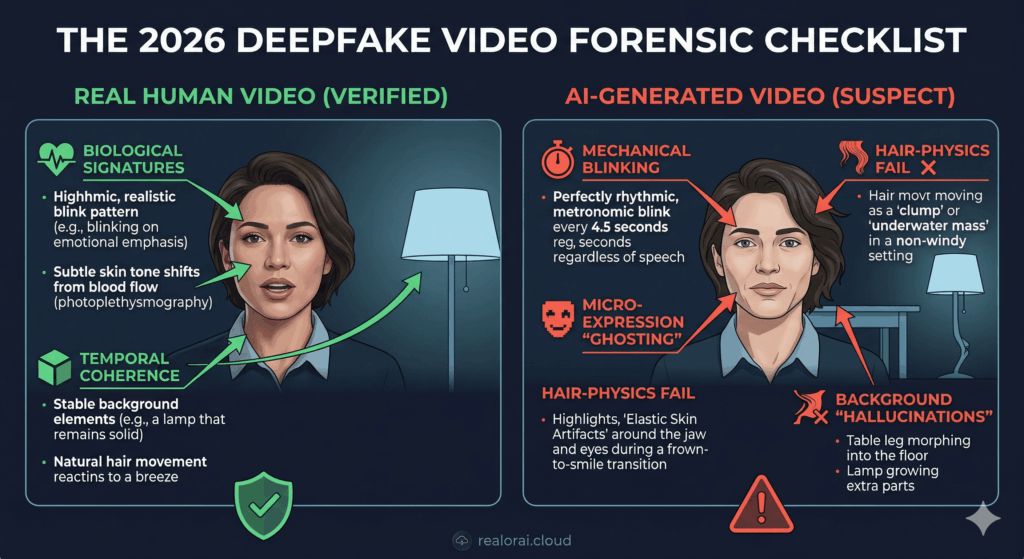
1. The Dry-Eye Syndrome (Blink Rates)
AI has learned to make people blink, but it hasn’t mastered the why. Real humans blink based on emotional state, conversation pace, or environmental irritants. AI video often features a “mechanical blink” a rhythmic, perfectly timed shutter effect that happens every 4–6 seconds regardless of what the person is saying. If they look like they’re blinking on a metronome, it’s a fake.
2. Micro-Expression “Ghosting”
Pay attention to the transition between emotions. If a subject goes from a frown to a smile, look at the cheeks and the corners of the eyes. AI often “ghosts” the transition, where the pixels seem to slide over the skin rather than the muscles moving underneath. We call this Elastic Skin Artifacting.
3. The Hair-Physics Fail
This is a big one. In a real video, individual strands of hair react to wind and body movement independently. AI even the high-end Runway Gen-4 tends to treat hair as a “clump” or a single fluid mass. If the subject’s hair looks like it’s moving underwater while they’re standing in a breeze, you’ve caught a render.
4. Background “Hallucinations”
The reality is simpler than you think: AI is a world-class liar but a terrible architect. Look past the person’s face. Are the cars in the background morphing into the pavement? Does a lamp suddenly grow an extra arm when someone walks in front of it? This Background Instability is a dead giveaway of a frame-by-frame generative process.
If you want to test your own skills, the MIT Media Lab’s Detect Fakes project is a great place to start.
The 2026 Video Toolbox: Best Deepfake Detection Software Reviewed
You can’t rely on your eyes alone when the stakes are high—like a video of a CEO announcing a merger or a politician making a “leak.” At RealOrAI, we use these three power tools to strip away the digital mask.
- Intel FakeCatcher: This is the heavyweight champion. It doesn’t look at pixels; it looks for Blood Flow. It detects the microscopic color changes in the skin caused by a heartbeat (photoplethysmography). If there’s no pulse in the video, it’s 100% synthetic.
- RealityCheck.ai: This tool focuses on Geometric Consistency. It maps the 3D structure of the head and checks if the lighting stays mathematically consistent across every frame. AI usually fails this “Light-Source Audit.”
- Microsoft Video Authenticator: Specifically designed for the 2026 election cycle, this tool checks for C2PA Metadata. If a video doesn’t have a secure “birth certificate” from a verified camera, it flags it as “High-Risk.”
Technical Breakdown: Sora vs. Veo and the Battle of AI Titans
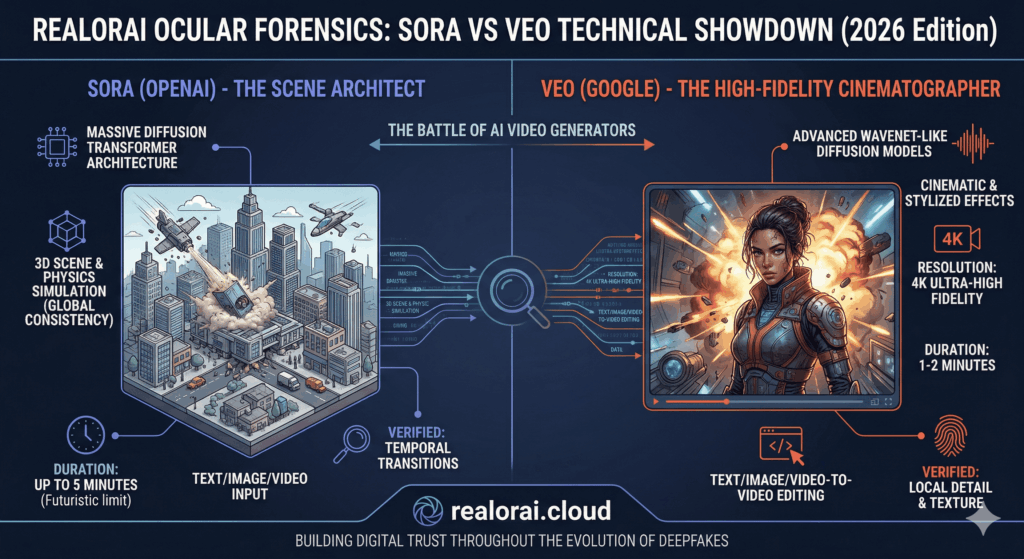
The tech has moved from “guessing pixels” to “simulating physics.” Here is the state of the art.
OpenAI Sora (The Physics King)
Sora changed the game by using a Spatiotemporal Transformer. Instead of generating one frame at a time, it creates the entire volume of the video at once. This fixed the “jitter” we saw in 2024. However, it still struggles with Causal Logic. If someone takes a bite of a cookie, the cookie might not have a bite mark in the next frame.
While OpenAI recently announced a shift in Sora’s public availability (March 2026), its underlying physics engine remains the benchmark for temporal coherence.
Google Veo (The Lighting Master)
Veo is currently the king of Cinematic Fidelity. Its strength lies in Subsurface Scattering the way light enters the skin and bounces around. While it makes people look “alive,” it often over-polishes the scene. Everything looks like a high-budget Marvel movie, which is itself a red flag for a “candid” cell phone video.
Tech Hub Insights: The “Pune Connection” in Global AI Quality Assurance
Here’s the kicker: your ability to spot these fakes today is thanks to the massive tech corridors in Pune, India. In areas like Hinjewadi Phase III, thousands of Quality Assurance (QA) engineers are working on Human-in-the-Loop (HITL) datasets.
They spend their shifts manually tagging “frame-to-frame inconsistencies” in the raw output of these models. When we analyzed these samples at RealOrAI, we noticed that many deepfakes still carry Annotator Bias. Since the AI was trained by humans flagging specific errors, it gets very good at hiding those errors but leaves others untouched.
Essentially, the “perfect” AI video you see is only “perfect” because someone in a Pune IT park told the model to stop making the shadows look like ink blots. But the human eye always leaves a trace of its own expectations, and that’s where we find the cracks.
Why It Matters: Visual Trust and the High Stakes of Deepfake Scams
We aren’t just talking about funny memes. In 2026, Synthetic Extortion is a billion-dollar industry. We’ve seen “Video Voice Phishing” (VVP) scams where an employee gets a “FaceTime” from their boss asking for an emergency wire transfer.
The reality is simpler than you think: if you can’t verify the “Biological Signature” of a video, you’re a target. The Liar’s Dividend the ability for real people to claim real evidence is “just a deepfake” is the ultimate threat to our legal system. Verification isn’t just a tech hobby; it’s digital self-defense.
Forensic Verdict Table: Human vs. AI Video Integrity Check
| Forensic Marker | Human-Likelihood Trait | AI-Likelihood Trait | AI Probability |
| Pulse Detection | Rhythmic skin-tone shifts | Flat, static pixel color | Critical |
| Blink Pattern | Contextual/Irregular | Rhythmic/Metronomic | High |
| Temporal Coherence | Consistent background physics | Morphing/Vanishing objects | Critical |
| Ear/Neck Junction | Sharp, distinct anatomy | Blurred or “melted” edges | Medium |
| Micro-Expressions | Muscle-driven skin folding | Geometric sliding (Ghosting) | High |
| Audio-Lip Sync | Perfect 1:1 millisecond match | Tiny “micro-drifts” in timing | Medium |
FAQ: Top Questions on Deepfake Video Detection Answered
1. Can deepfakes be created in real-time during a call? Yes. In 2026, low-latency models can “skin” a face onto a caller in under 50 milliseconds. Always ask the caller to turn their head sharply to the side most real-time fakes will “glitch” at the ear-line.
2. Does 4K resolution make fakes easier to spot? Actually, it makes it harder. Higher resolution gives the AI more “canvas” to hide small errors in texture. You have to zoom in on the eyes and hair to find the math.
3. Is there a law against deepfakes in 2026? Under the India IT Rules 2026, creating or sharing non-consensual deepfakes is a criminal offense with a mandatory 24-hour takedown window for platforms.
4. Can I use a regular antivirus to stop deepfakes? No. Standard antivirus software looks for malicious code; deepfakes are just “malicious pixels.” You need specialized tools like Intel FakeCatcher.
5. Why do AI videos still look “dreamy”? This is due to Gaussian Blur used to hide the transitions between generated frames. If a video feels like it has a “soft focus” filter that you can’t turn off, be suspicious.
6. What is “Temporal Jitter”? It’s the “shaking” you see in the background of AI videos. It happens because the AI doesn’t remember exactly where it put a leaf or a pebble in the previous frame.
7. Can AI mimic my voice perfectly too? Unfortunately, yes. Audio deepfakes are actually ahead of video deepfakes. Always use a “Safe Word” with your family for high-stakes requests.
8. How does Pune fit into this? Pune is a global hub for AI training and QA. Much of the data-labeling that teaches AI how to look “real” happens in Indian tech parks, providing a unique vantage point on how these models are built and where they fail.